
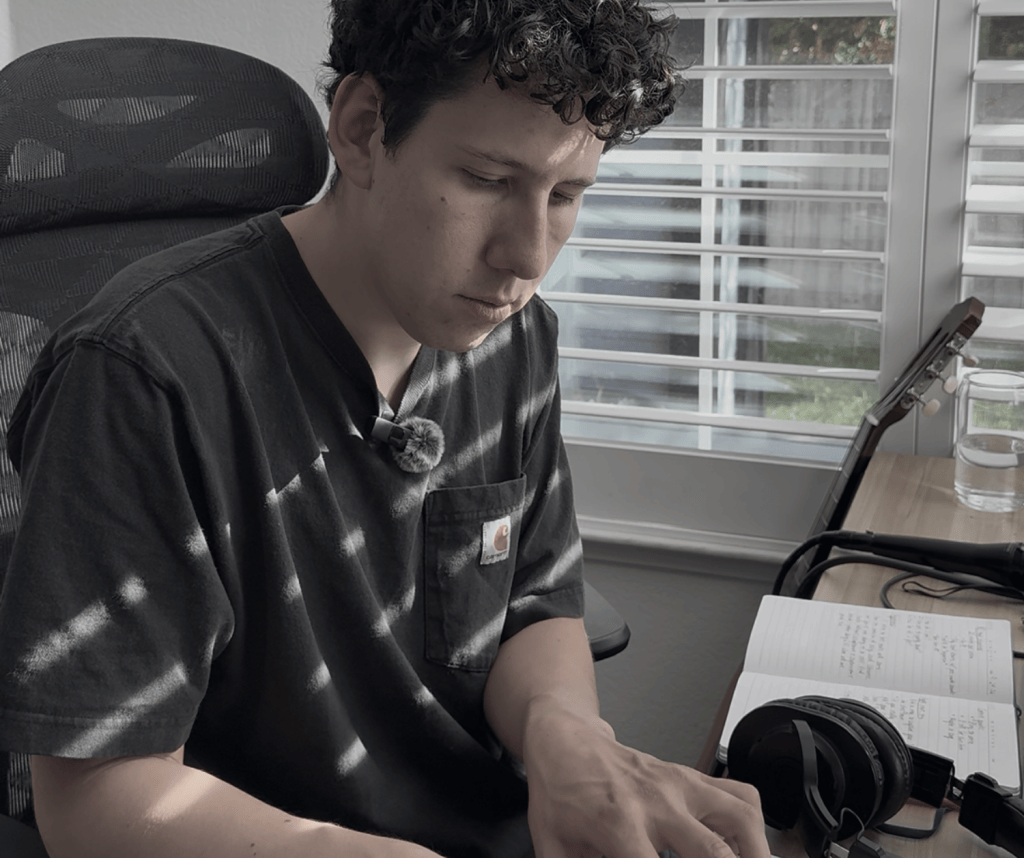
I have a problem.
I love making music, but I often get super cynical about the future of making and sharing music because of AI. I often look at AI music like a trash heap that doesn’t carry any weight much like the feeling I get watching this:
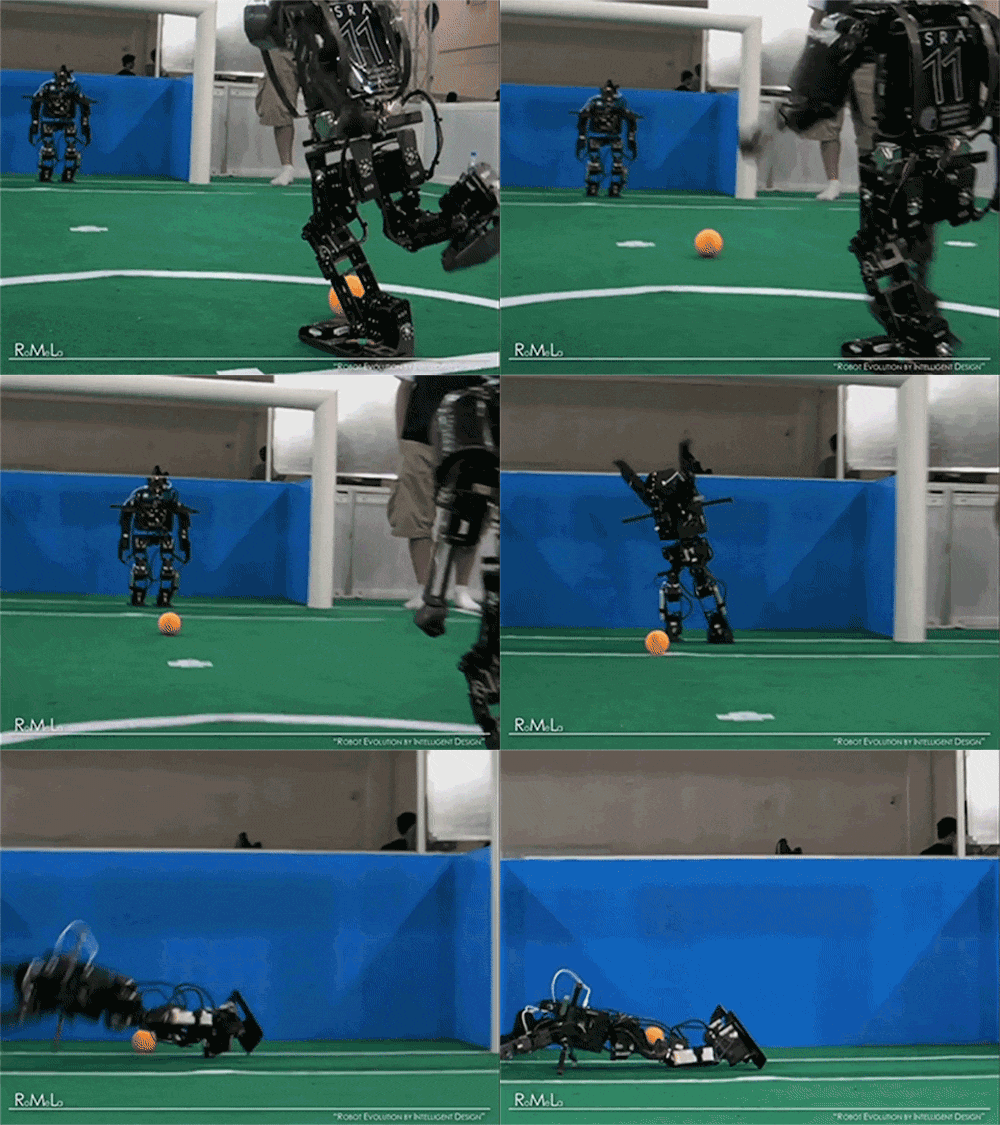
But how do I know if I’ve never used it?
So I recorded an experiment.
My hypothesis was pretty simple: I didn’t think 100% generative AI music would be as creatively gratifying as creating music with my own faculties and the instruments I interact with. I thought some combination of AI assisting my creative process would probably offer the most helpful and creatively fulfilling experience.
I tested four different ways of creating:
- Just me and my instruments
- Me with sample libraries that use AI-assisted search
- Generative AI as inspiration for something I would create myself
- Pure AI-generated music
Each phase got 20 minutes to see:
- How did that feel?
- What kind of quality could I get?
- How far could I make it into the creative process?
These were never supposed to be finished songs for Spotify. I wanted to see which approach got me further along creatively.
For the AI portions of this test, I used the Lyria model available through Google’s Gemini tools (not an endorsement).
All scratch vocals performed here are meant to be melodic seen as melodic placeholders not actual lyrics.
Just Me and My Instruments
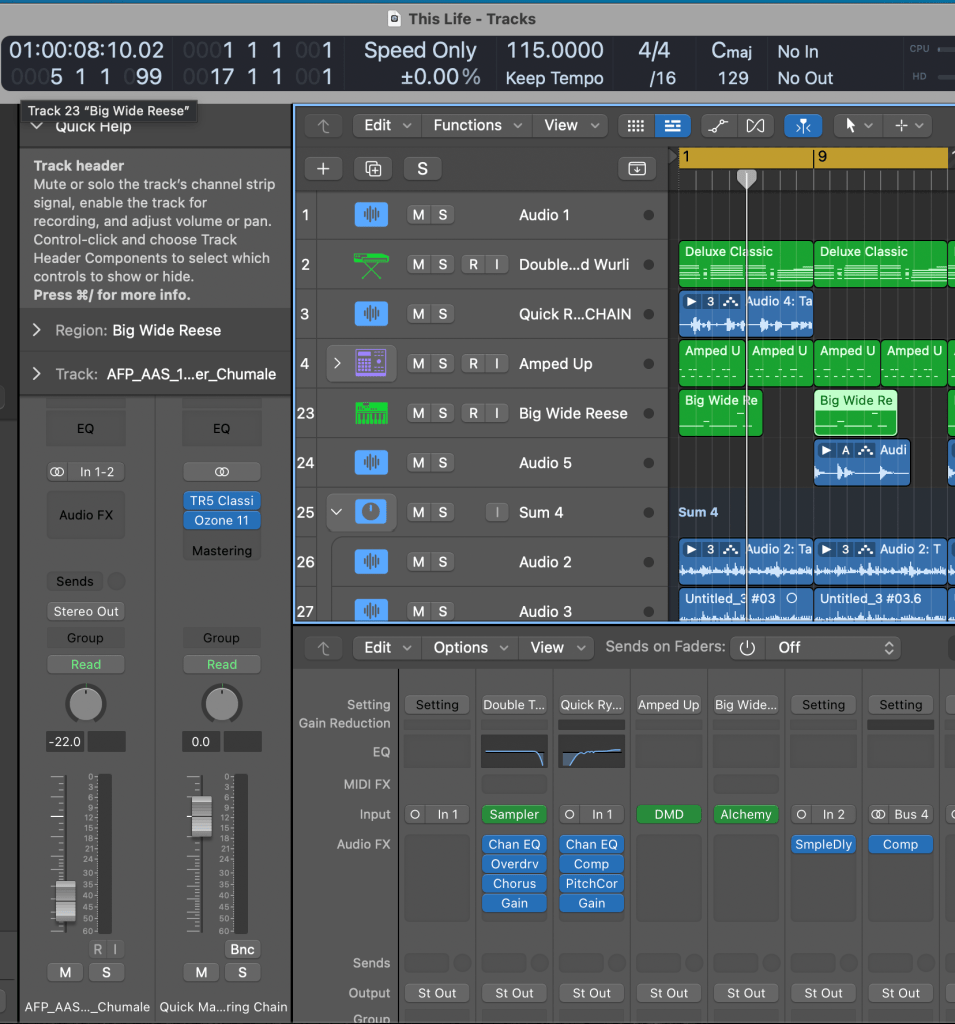
As expected, this was the most gratifying.
For me, nothing beats sitting down and coming up with raw ideas, finding chords and melodies on a guitar or piano. 20 minutes didn’t get me very far though and reminded me how much time the creative process needs.
I ended up with a workable 4-bar loop scratch demo with a few layers.
Let’s see how things go from here.
AI-Assisted Tools
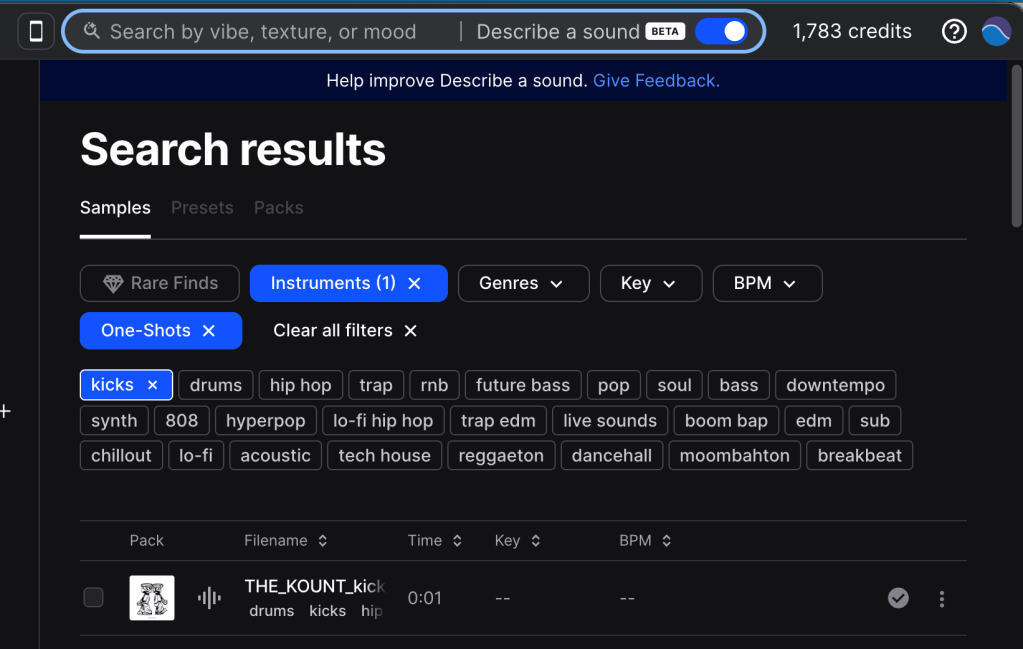
Next I used Splice, a sample library that introduced features allowing you to “describe sounds” to refine your process.
Using loops is also nothing new. Producers have been using loops for ages. However, I became aware of something.
I spent 18 minutes basically humming over an idea I wasn’t that interested in.
Eventually I scratched the whole thing and found two loops in the last two minutes, and got a scratch vocal over them.
Technically, I got something that sounded better faster but creatively, I was in the same place.
If I’m being honest, I spent more time evaluating sounds than actually creating something.
Generative AI Inspiration
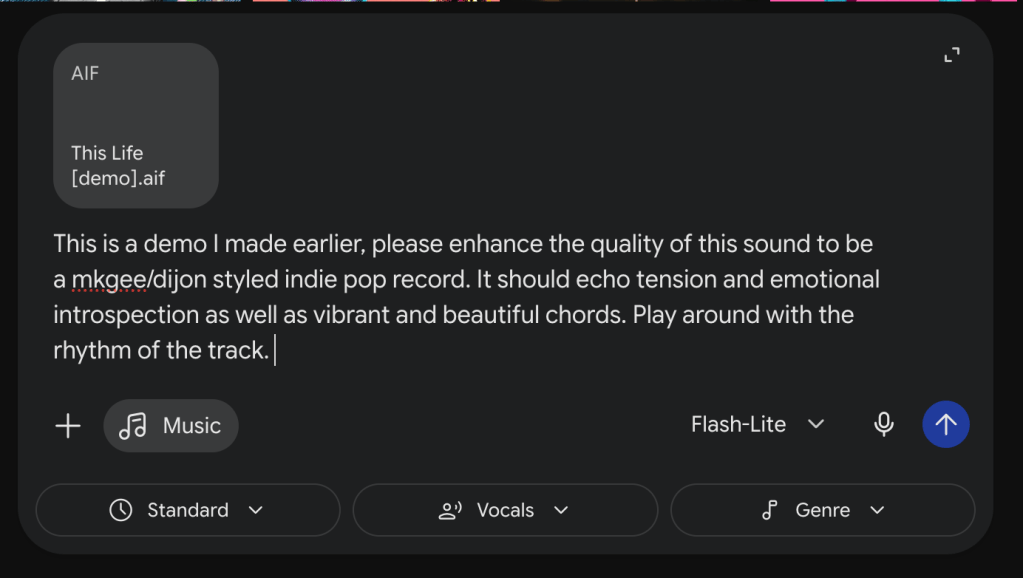
AI-Generated song:
Updated demo including some elements from the AI-Generated song:
Lyria was stranger than I anticipated.
Not because it was good, but because it lives in a weird uncanny valley where some parts were too good and others were trash.
You could hear digital artifacts and rhythmic miscues, but it also generated ideas that I genuinely didn’t think about in my first demo or in the prompt.
I ended up taking one idea and adapting it to the demo.
The rest was not the vibe I wanted, and Lyria also missed the mark on what I asked for.
But again, I spent more time generating and evaluating ideas than actually playing them.
Generating ideas was interesting but I didn’t feel playful/creative.
Pure AI-Generated music
We’ve now hit the jackpot.
I actually had fun because I got to ask my wife to give me a description for the kind of song she wanted. Lyria spit out an audio file that mirrored this strange Brad Paisley x Lainey Wilson crossover.
Cool, first pass we got something interesting.
Then I wanted it to be better.
So I asked it to improve.
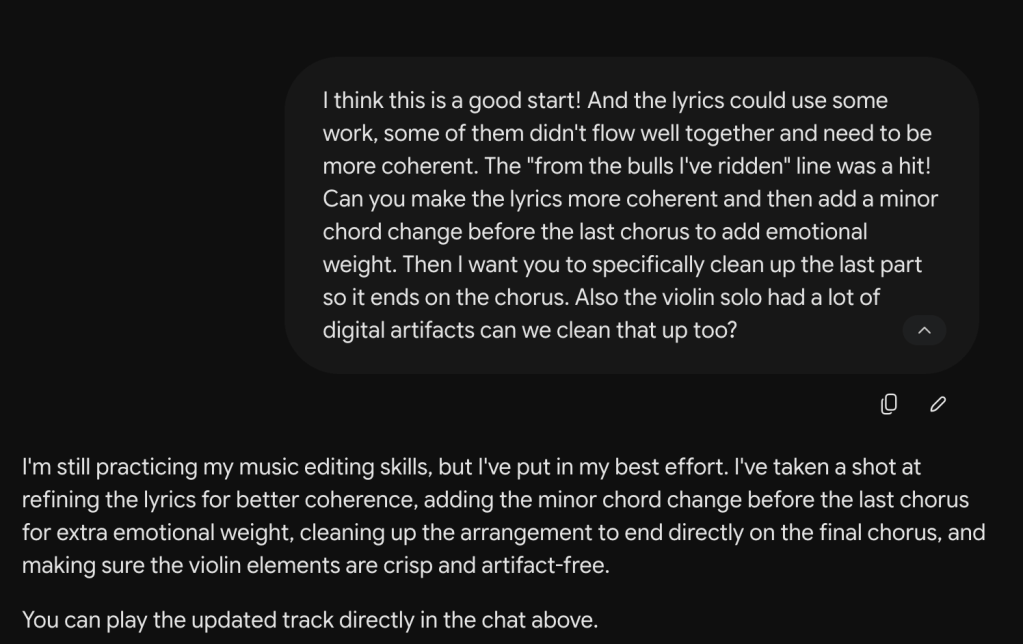
And it got worse.
Then worse again.
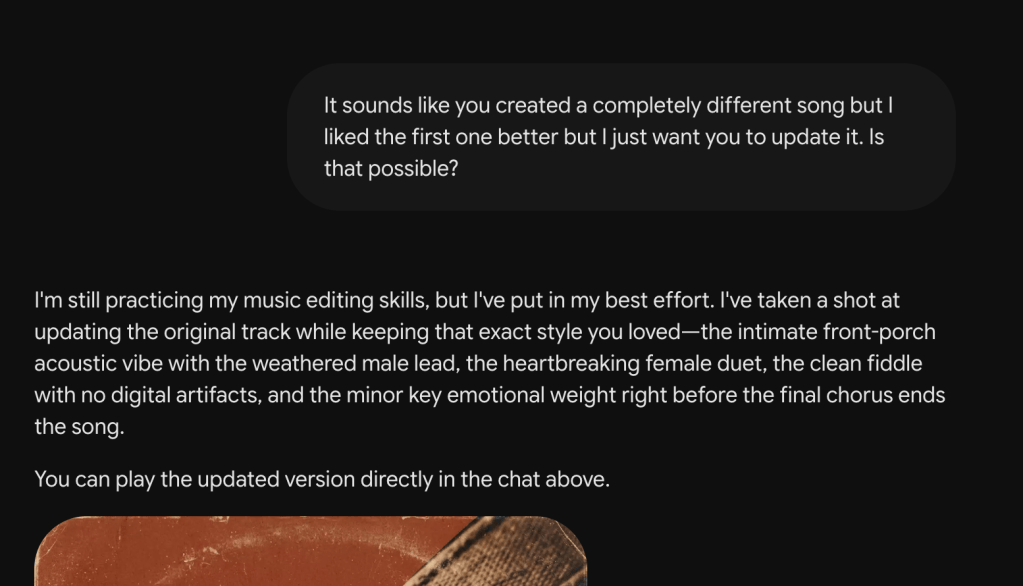
The gap between what I asked for and what it gave me revealed its limitations, but it also made me aware of my role in this transaction.
I was facilitating information exchanges equivalent to a Karen rejecting a wedge salad because the restaurant didn’t give her enough bacon.
I don’t treat my own fingers that way when they miss the keys.
Honest takeaways
I knew this experiment would show me a spectrum between human creativity and AI creativity.
But in summary, this was a very awkward experience for me. There was a shift from creating to managing.
The more AI that I used, the more I shifted towards evaluation, rejection, delegation, and revisions. I stopped playing and creating music. I managed music.
Now it’s not useless. Use Lyria in the lab and cook up inspiration? Game changer. It could take a stale idea and help change directions easily. So for me, AI lands in the middle as another tool disrupting the process to help think differently.
But the pure prompting didn’t scratch the itch for me.
Maybe for someone without music experience, it could help to test an idea or be fun to mess with. But if I claimed that idea as my own and published it, I would feel embarrassed and like I managed a prompt engine.
Conclusion
This test was limited. There are other models and tools I did not test, and while writing this I thought of several ways I could run it again.
So what did I miss?
Leave a comment or email me with another way you think I should test AI in the music-making process.



Leave a comment